
A private-label glue trap program succeeds or fails at the specification sheet. Supermarket, e-commerce and garden brands that send the factory a complete spec — size, glue weight, packaging and artwork — get accurate quotes, faster samples and no surprises when the container arrives. Vague briefs like "standard sticky trap, good quality" produce exactly the opposite. Here is how to write a spec your manufacturer can price and produce without guesswork.
Size: Match Board Dimensions to Your Channel
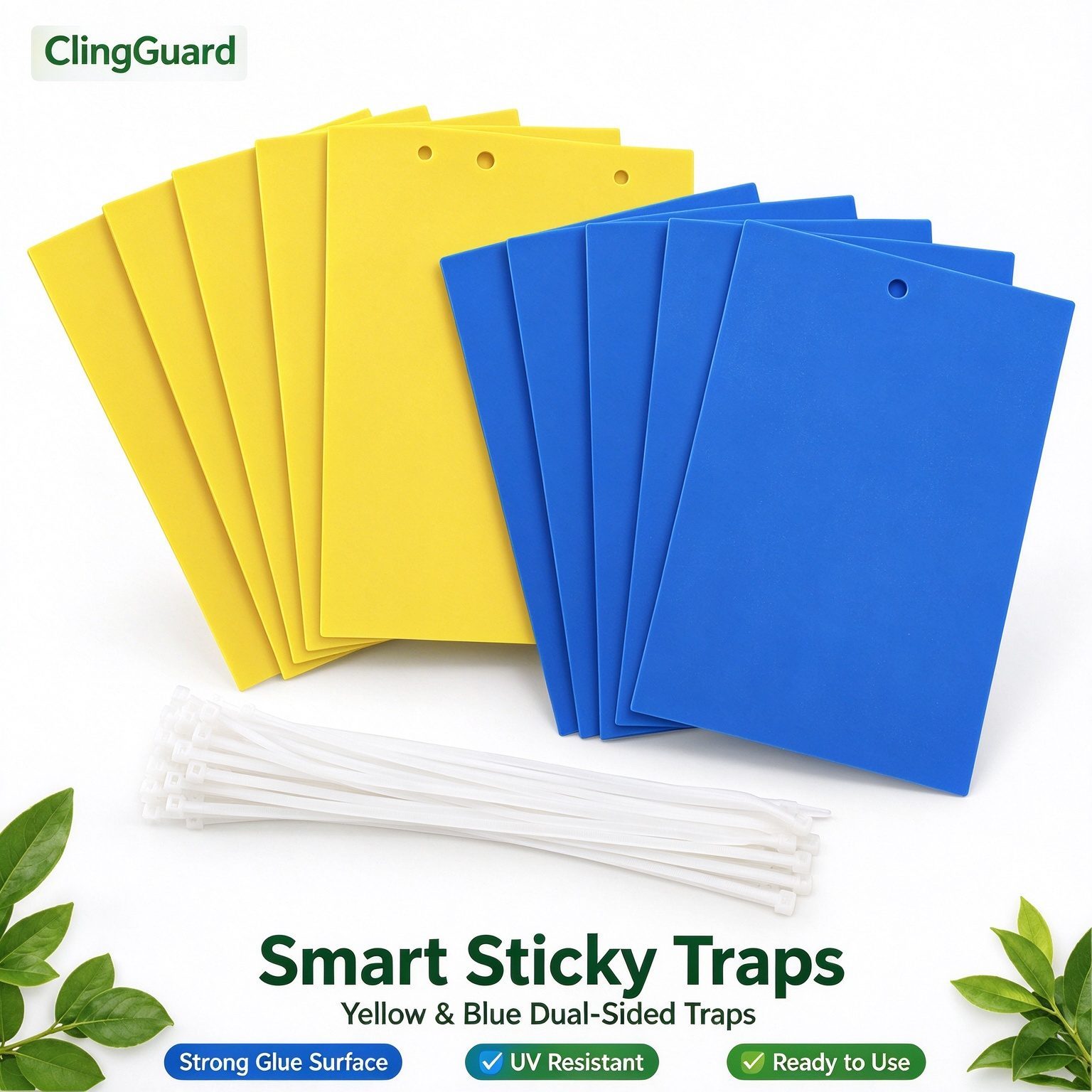
Industry-standard dimensions fit established shelving and user habits. Rodent lines typically run 17 × 11 cm mouse boards and 34 × 22 cm rat boards; agricultural cards center on 15 × 20 cm, with larger formats for mass trapping. Channel matters: supermarket retail favors compact boards in multi-packs, while garden centers and greenhouse suppliers stock bigger cards. The UC IPM guidelines on monitoring with sticky traps show why — monitoring programs use small cards at low density, while mass-trapping programs need far more glue surface per hectare. Our yellow & blue sticky traps, for example, ship in the 15 × 20 cm agricultural standard with custom sizes on request.
Glue Weight: Specify Grams, Not "Extra Sticky"
Glue weight is the single biggest driver of both capture performance and unit cost, so put numbers on it. Typical industry ranges: 15–25 g per mouse board, 30–45 g per rat board, and 12–18 g double-sided on agricultural cards. Pair the weight with a temperature window — standard formulas perform between 10 and 43 °C, while cold-resistant blends hold tack down to −17 °C for walk-in coolers and unheated warehouses. Always state a tolerance (±10% is common) and the test temperature, so batch inspections compare like with like.

Packaging: From Single Bag to Shelf-Ready Carton
Define the full packaging stack: traps per retail unit (single polybag, 2-pack, 5- or 10-pack printed color box), retail units per master carton, carton dimensions and gross weight. Add barcode requirements (EAN/UPC), multilingual label needs and any market-specific warnings. One regulatory note for the U.S.: glue boards and fly paper are classed as pesticidal devices — the U.S. EPA's device guidance confirms they need no product registration, but 40 CFR § 152.500 still applies its labeling rules, so keep claims factual and substantiated. Poison-free traps are also a natural fit where the FDA Food Code requires pest-free food premises without pesticide residues.
Artwork: Print Files, Dielines and Custom Shapes
Ask the factory for its dieline first, then build artwork to it: vector PDF or AI files, CMYK color, 3 mm bleed, and fonts outlined. Budget a one-time plate charge per design. Shapes are a genuine differentiator: die-cut flower-shaped sticky traps turn a commodity card into a giftable garden product. Keep MOQ reality in view — 1,000 pcs per design (mixed SKUs accepted) is a workable industry baseline.

Put Your Private Label Glue Traps Spec on One Page
A complete spec sheet fits on a single page: board dimensions, glue weight with tolerance and temperature range, packaging stack with barcode, and artwork status. Brands that specify private label glue traps this way typically move from inquiry to approved sample in one round — at ClingGuard, samples ship in 3–7 days and mass production runs 15–25 days after proof approval. Send us your spec, or ask for our blank template and free samples to start.
Ready to spec your private label glue traps? Request our specification sheet template, free samples (freight collect) or an OEM quotation from our team.
Request a Quote Browse All Products